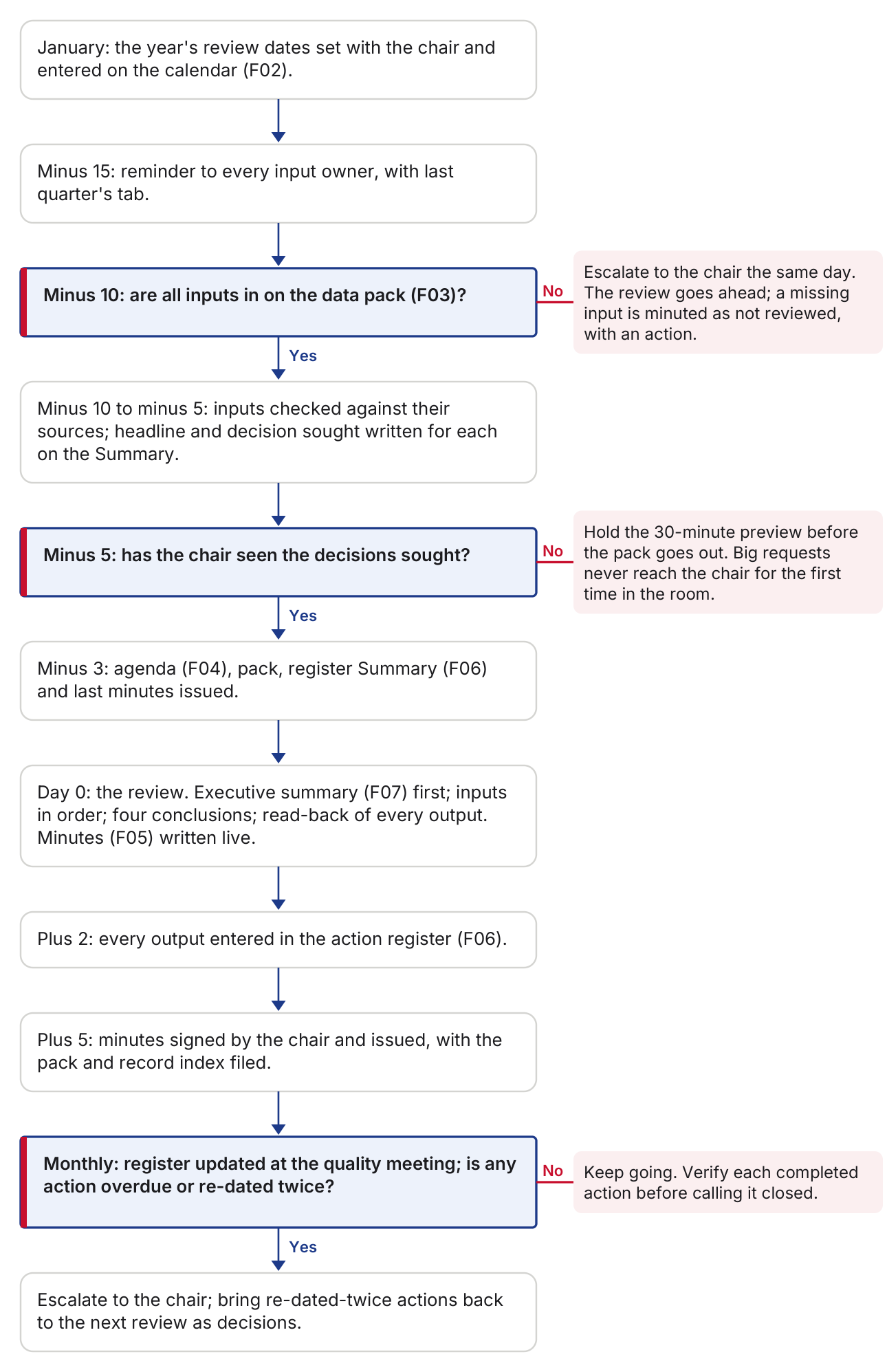
Every review moves through the same steps, counted in working days before and after the meeting. The shaded boxes are checks: Yes continues down, No goes to the note on the right.
- January: the year's review dates set with the chair and entered on the calendar (F02).
- Minus 15: reminder to every input owner, with last quarter's tab.
- No:Escalate to the chair the same day. The review goes ahead; a missing input is minuted as not reviewed, with an action.
- Minus 10 to minus 5: inputs checked against their sources; headline and decision sought written for each on the Summary.
- Decision: Minus 5: has the chair seen the decisions sought? If yes, continue to the next step.No:Hold the 30-minute preview before the pack goes out. Big requests never reach the chair for the first time in the room.
- Plus 2: every output entered in the action register (F06).
- Plus 5: minutes signed by the chair and issued, with the pack and record index filed.
- Decision: Monthly: register updated at the quality meeting; is any action overdue or re-dated twice? If yes, continue to the next step.No:Keep going. Verify each completed action before calling it closed.
- Escalate to the chair; bring re-dated-twice actions back to the next review as decisions.
| When | What happens | Who | Tool |
|---|---|---|---|
| January | Set every review date for the year with the chair; confirm the owner and backup of each input | Quality manager, chair | F02 |
| Minus 15 | Remind each input owner of their due date | Quality manager | F02 |
| Minus 10 | Inputs due: owners fill their tabs, with comments that name what is behind each trend | Input owners | F03 |
| Minus 10 to 5 | Check every input against its source; write the headline and decision sought | Quality manager | F03 |
| Minus 5 | Thirty minutes with the chair on the decisions sought | Quality manager, chair | F03, F04 |
| Minus 3 | Issue the agenda, pack, register Summary and last minutes | Quality manager | F04, F03, F06 |
| Day 0 | Hold the review; record decisions live; read them back | Chair, attendees | F07, F05 |
| Plus 2 | Enter every output in the action register | Quality manager | F06 |
| Plus 5 | Issue the signed minutes | Quality manager, chair | F05 |
| Monthly | Update the register; chase overdue and due-soon actions; verify completed ones | Quality manager, owners | F06 |
Need more than one resource, or not sure where to start? Book a complimentary 30-minute Aegis Quality Guidance Call. We'll find the tools that fit your situation and a sensible place to start. No sales pressure, no obligation.
A management aid, not certification or a registrar audit. Using it does not by itself show conformity to AS9100D or any other standard, and your customers' requirements may add to it.
Clause numbers refer to AS9100D (SAE AS9100 Rev D) unless another document is named. The standards' text is not reproduced here: use your own licensed copy.
Aegis Insights are our own guidance, labeled wherever they appear: how we approach this work, not a requirement of any standard or customer.