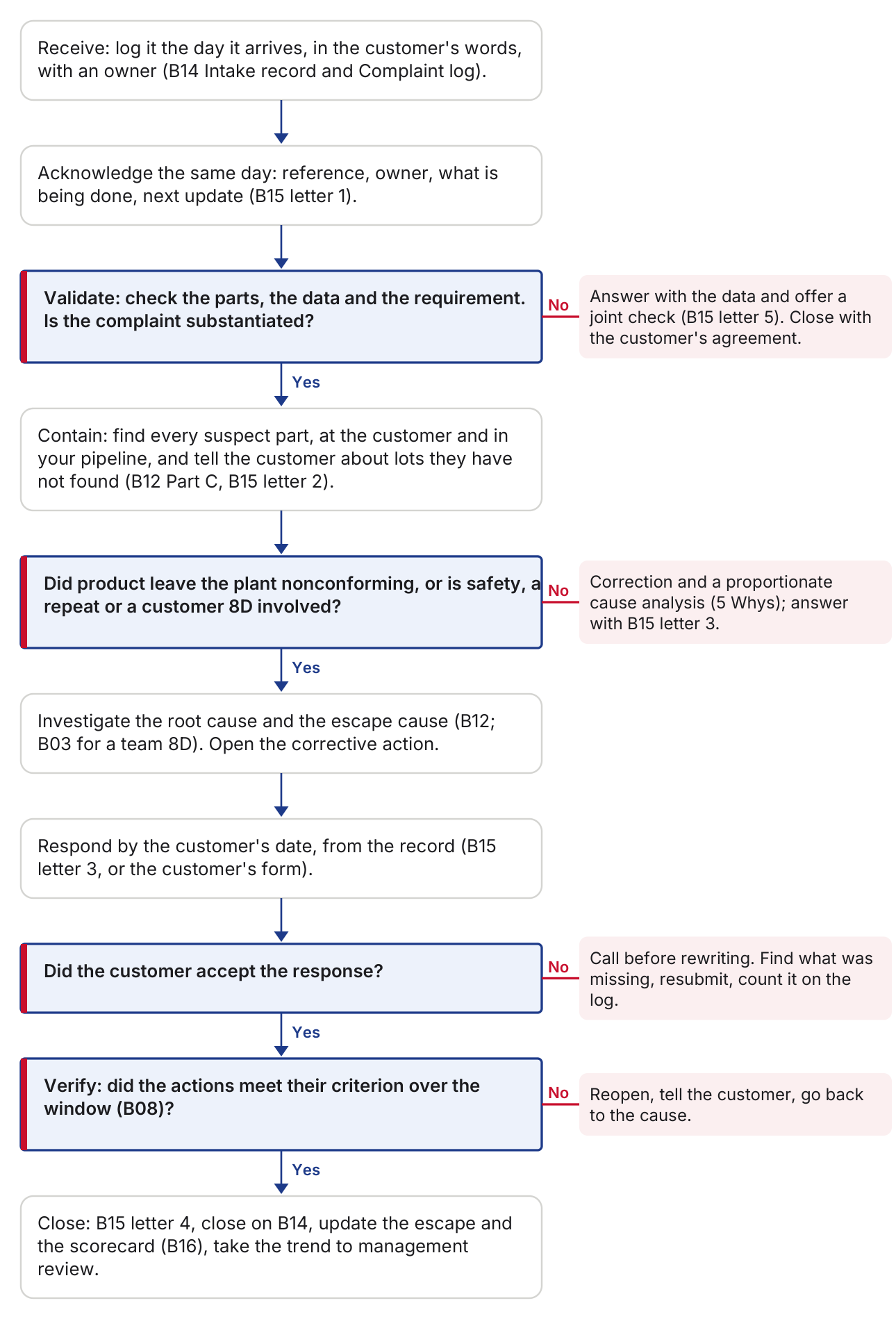
Every complaint, whatever its type, moves through the same stages. The shaded boxes are decisions: Yes continues down, No goes to the note on the right.
- Receive: log it the day it arrives, in the customer's words, with an owner (B14 Intake record and Complaint log).
- Acknowledge the same day: reference, owner, what is being done, next update (B15 letter 1).
- Decision: Validate: check the parts, the data and the requirement. Is the complaint substantiated? If yes, continue to the next step.No:Answer with the data and offer a joint check (B15 letter 5). Close with the customer's agreement.
- Decision: Did product leave the plant nonconforming, or is safety, a repeat or a customer 8D involved? If yes, continue to the next step.No:Correction and a proportionate cause analysis (5 Whys); answer with B15 letter 3.
- Respond by the customer's date, from the record (B15 letter 3, or the customer's form).
- Decision: Did the customer accept the response? If yes, continue to the next step.No:Call before rewriting. Find what was missing, resubmit, count it on the log.
- Decision: Verify: did the actions meet their criterion over the window (B08)? If yes, continue to the next step.No:Reopen, tell the customer, go back to the cause.
| Stage | Purpose | Tools | Output | AS9100D |
|---|---|---|---|---|
| Receive | One front door; nothing lost | B14 | A logged complaint with an owner | 8.2.1 |
| Acknowledge | The customer knows someone has it | B15 letter 1 | A dated acknowledgment | 8.2.1 |
| Validate | Know whether the claim holds before acting on it | B14, B12 Part A | Substantiated: Yes, Partly or No, with the evidence | 8.7, 8.2.1 |
| Contain | Protect the customer now | B12 Part C, B15 letter 2 | Every suspect part found; the customer told | 8.7.1 |
| Investigate | Root cause and escape cause, confirmed | B12, B03 | Confirmed causes; a corrective action opened | 10.2.1 |
| Respond | An answer the customer can accept | B15 letter 3 | A response sent on time | 8.2.1, 10.2.1 |
| Verify and close | Show it worked; close on evidence | B08, B15 letter 4, B14 | A closed complaint with acceptance and evidence on file | 10.2.1, 10.2.2 |
| Learn | See the pattern across complaints and customers | B14, B16 | Monthly view; management review input | 9.1.2, 9.1.3, 9.3.2 |
Need more than one resource, or not sure where to start? Book a complimentary 30-minute Aegis Quality Guidance Call. We'll find the tools that fit your situation and a sensible place to start. No sales pressure, no obligation.
A management aid, not certification or a registrar audit. Using it does not by itself show conformity to AS9100D or any other standard, and your customers' requirements may add to it.
Clause numbers refer to AS9100D (SAE AS9100 Rev D) unless another document is named. The standards' text is not reproduced here: use your own licensed copy.
Aegis Insights are our own guidance, labeled wherever they appear: how we approach this work, not a requirement of any standard or customer.