This kit treats three things that are often run separately as one system. Each answers a different question, and each fails without the other two.
| Control | The question it answers | What it covers | Kit tool | AS9100D |
|---|---|---|---|---|
| Configuration identification and status accounting | What exactly is this part, today, and which product was made to which revision? | Each part's released revision and everything that defines and makes it: drawing, model, specifications, router, programs, inspection plan, key characteristics, FAI; the history of every change with its effectivity | D10 | 8.1.2, 8.5.2 |
| Change control | Is this change assessed, approved and carried everywhere it lands before product is made to it? | Customer drawing, specification and order changes; our own engineering changes; process changes; supplier changes | D11, E13, C14 | 8.5.6, 8.2.4, 8.3.6, 8.4.3 |
| Documented information control | Is the document or program at the point of use the current, approved revision, and nothing else? | Approval, identification, distribution, withdrawal of old copies, external documents, records | A13 | 7.5.3 |
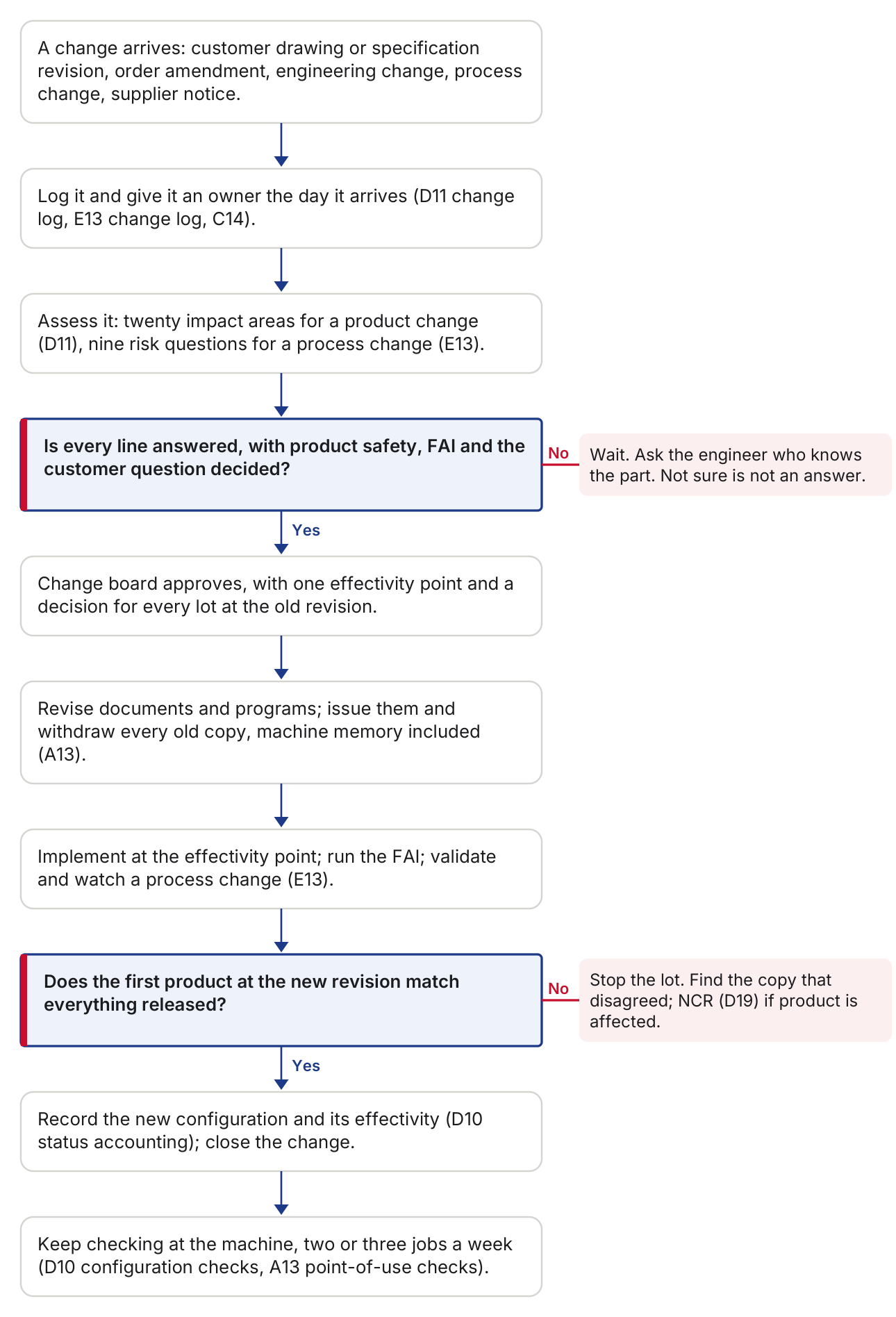
The joins between them are where changes fail. A change approved in D11 creates new revisions of documents and programs, which A13 issues and withdraws. Once they are in place, D10 records the new configuration and its effectivity, and its configuration checks confirm at the machine that what is being built matches what was released. A process change in E13 follows the same path. If any join is missing, the system leaks.
- A change arrives: customer drawing or specification revision, order amendment, engineering change, process change, supplier notice.
- Decision: Is every line answered, with product safety, FAI and the customer question decided? If yes, continue to the next step.No:Wait. Ask the engineer who knows the part. Not sure is not an answer.
- Change board approves, with one effectivity point and a decision for every lot at the old revision.
- Revise documents and programs; issue them and withdraw every old copy, machine memory included (A13).
- Implement at the effectivity point; run the FAI; validate and watch a process change (E13).
- Decision: Does the first product at the new revision match everything released? If yes, continue to the next step.No:Stop the lot. Find the copy that disagreed; NCR (D19) if product is affected.
- Record the new configuration and its effectivity (D10 status accounting); close the change.
Need more than one resource, or not sure where to start? Book a complimentary 30-minute Aegis Quality Guidance Call. We'll find the tools that fit your situation and a sensible place to start. No sales pressure, no obligation.
A management aid, not certification or a registrar audit. Using it does not by itself show conformity to AS9100D or any other standard, and your customers' requirements may add to it.
Clause numbers refer to AS9100D (SAE AS9100 Rev D) unless another document is named. The standards' text is not reproduced here: use your own licensed copy.
Aegis Insights are our own guidance, labeled wherever they appear: how we approach this work, not a requirement of any standard or customer.