Even a good system will sometimes find product made to a superseded revision. The response has two jobs: protect the customer, and find the path the old copy took so it cannot take it again.
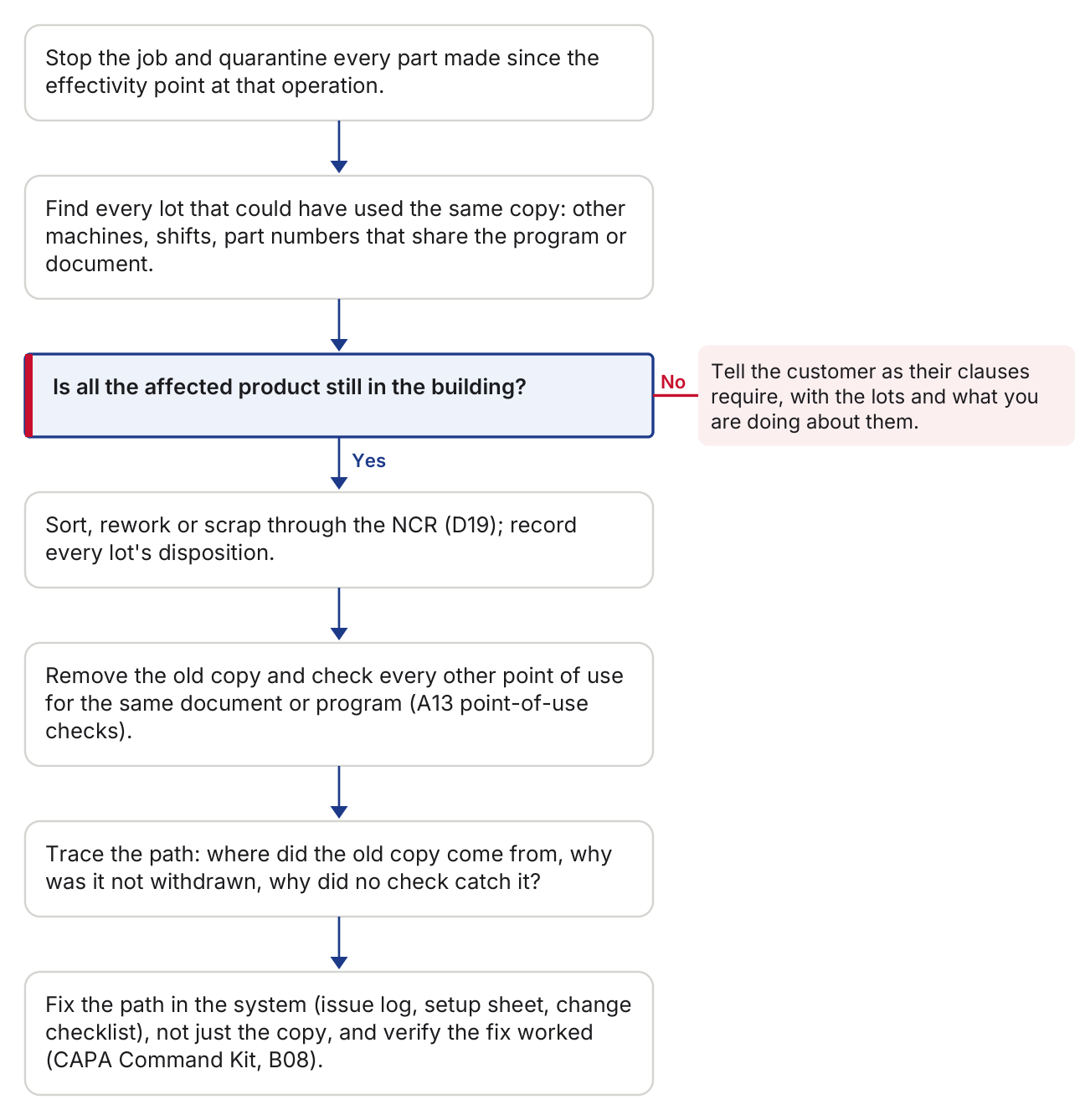
- Stop the job and quarantine every part made since the effectivity point at that operation.
- Find every lot that could have used the same copy: other machines, shifts, part numbers that share the program or document.
- Decision: Is all the affected product still in the building? If yes, continue to the next step.No:Tell the customer as their clauses require, with the lots and what you are doing about them.
- Sort, rework or scrap through the NCR (D19); record every lot's disposition.
- Remove the old copy and check every other point of use for the same document or program (A13 point-of-use checks).
- Trace the path: where did the old copy come from, why was it not withdrawn, why did no check catch it?
- Fix the path in the system (issue log, setup sheet, change checklist), not just the copy, and verify the fix worked (CAPA Command Kit, B08).
The trace usually ends at one of four places: an issue that listed fewer points of use than really existed; a withdrawal confirmed without anyone looking; a setup or first-piece check that compares nothing against the revision; or a change that skipped a line of the impact screen. Each has a fix in this kit.
Need more than one resource, or not sure where to start? Book a complimentary 30-minute Aegis Quality Guidance Call. We'll find the tools that fit your situation and a sensible place to start. No sales pressure, no obligation.
A management aid, not certification or a registrar audit. Using it does not by itself show conformity to AS9100D or any other standard, and your customers' requirements may add to it.
Clause numbers refer to AS9100D (SAE AS9100 Rev D) unless another document is named. The standards' text is not reproduced here: use your own licensed copy.
Aegis Insights are our own guidance, labeled wherever they appear: how we approach this work, not a requirement of any standard or customer.