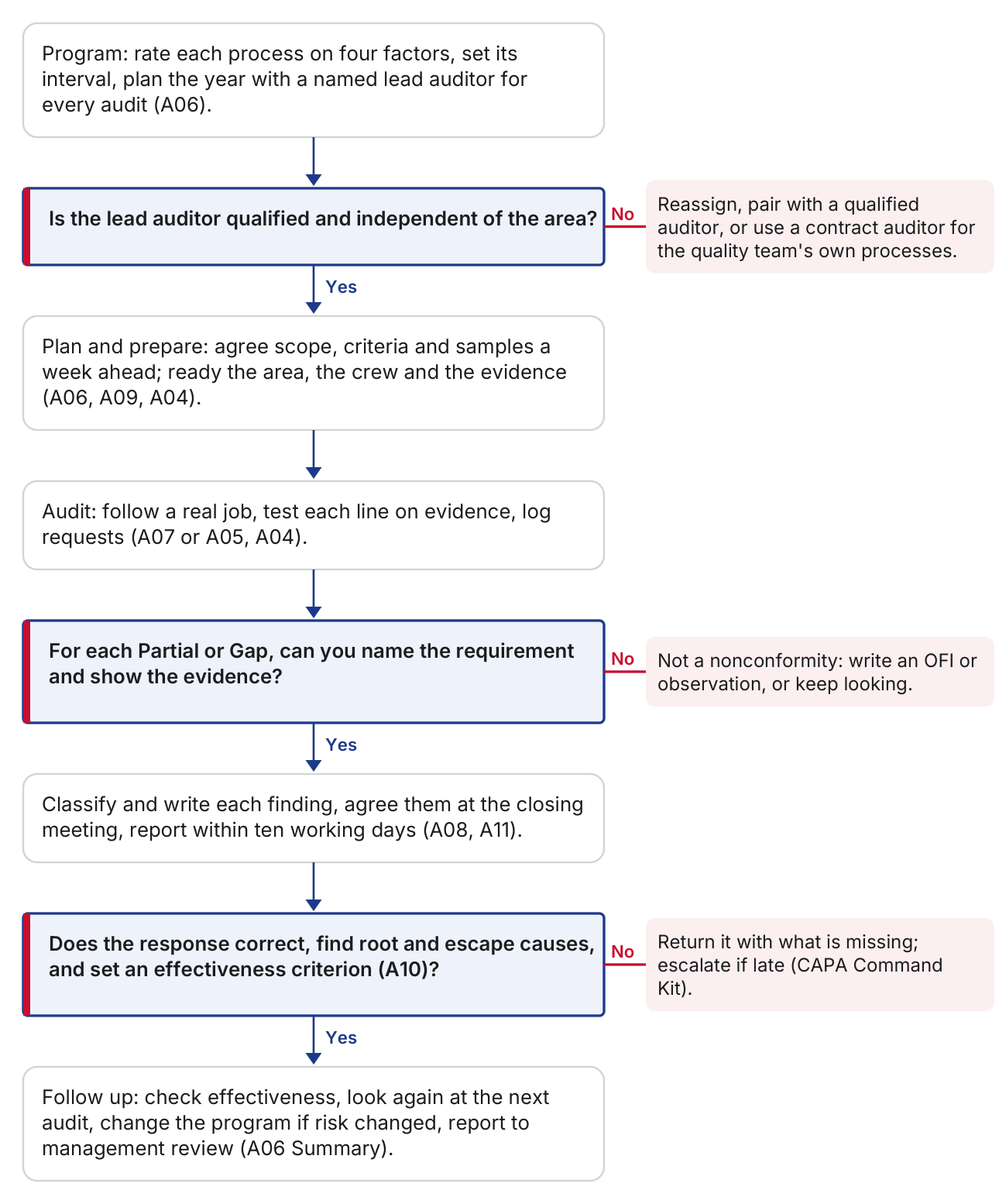
Every audit moves through the same stages, inside a program that is planned once a year and adjusted every month. The shaded boxes are gates: Yes continues down, No goes to the note on the right.
- Program: rate each process on four factors, set its interval, plan the year with a named lead auditor for every audit (A06).
- Decision: Is the lead auditor qualified and independent of the area? If yes, continue to the next step.No:Reassign, pair with a qualified auditor, or use a contract auditor for the quality team's own processes.
- Decision: For each Partial or Gap, can you name the requirement and show the evidence? If yes, continue to the next step.No:Not a nonconformity: write an OFI or observation, or keep looking.
- Decision: Does the response correct, find root and escape causes, and set an effectiveness criterion (A10)? If yes, continue to the next step.No:Return it with what is missing; escalate if late (CAPA Command Kit).
- Follow up: check effectiveness, look again at the next audit, change the program if risk changed, report to management review (A06 Summary).
| Stage | Purpose | Tools | Output | AS9100D |
|---|---|---|---|---|
| Program | Audit where the risk is, cover every process in the cycle | A06 | Process list, intervals, schedule, auditors | 9.2.1, 9.2.2 |
| Plan | Agree what will be audited, against what, how | A06 | Audit plan sent a week ahead | 9.2.2 |
| Prepare | Ready the area, the people and the evidence | A09, A04 | Area ready; evidence map checked | 7.5.3 |
| Audit | Test the process on evidence from the work | A07, A05, A04 | Checklist with evidence; request log | 9.2.2 |
| Findings | Classify and write findings that hold up | A08 | Findings agreed at the closing meeting | 9.2.2 |
| Report | Record what was found and concluded | A11 | Report issued within ten working days | 9.2.2, 7.5.3 |
| Respond | Remove the causes, prove it worked | A10, CAPA Command Kit | Accepted response; effectiveness checked | 10.2.1, 10.2.2 |
| Review | Keep the program moving and learn from it | A06 Summary | Monthly review; management review input | 9.1.3, 9.3.2 |
Need more than one resource, or not sure where to start? Book a complimentary 30-minute Aegis Quality Guidance Call. We'll find the tools that fit your situation and a sensible place to start. No sales pressure, no obligation.
A management aid, not certification or a registrar audit. Using it does not by itself show conformity to AS9100D or any other standard, and your customers' requirements may add to it.
Clause numbers refer to AS9100D (SAE AS9100 Rev D) unless another document is named. The standards' text is not reproduced here: use your own licensed copy.
Aegis Insights are our own guidance, labeled wherever they appear: how we approach this work, not a requirement of any standard or customer.