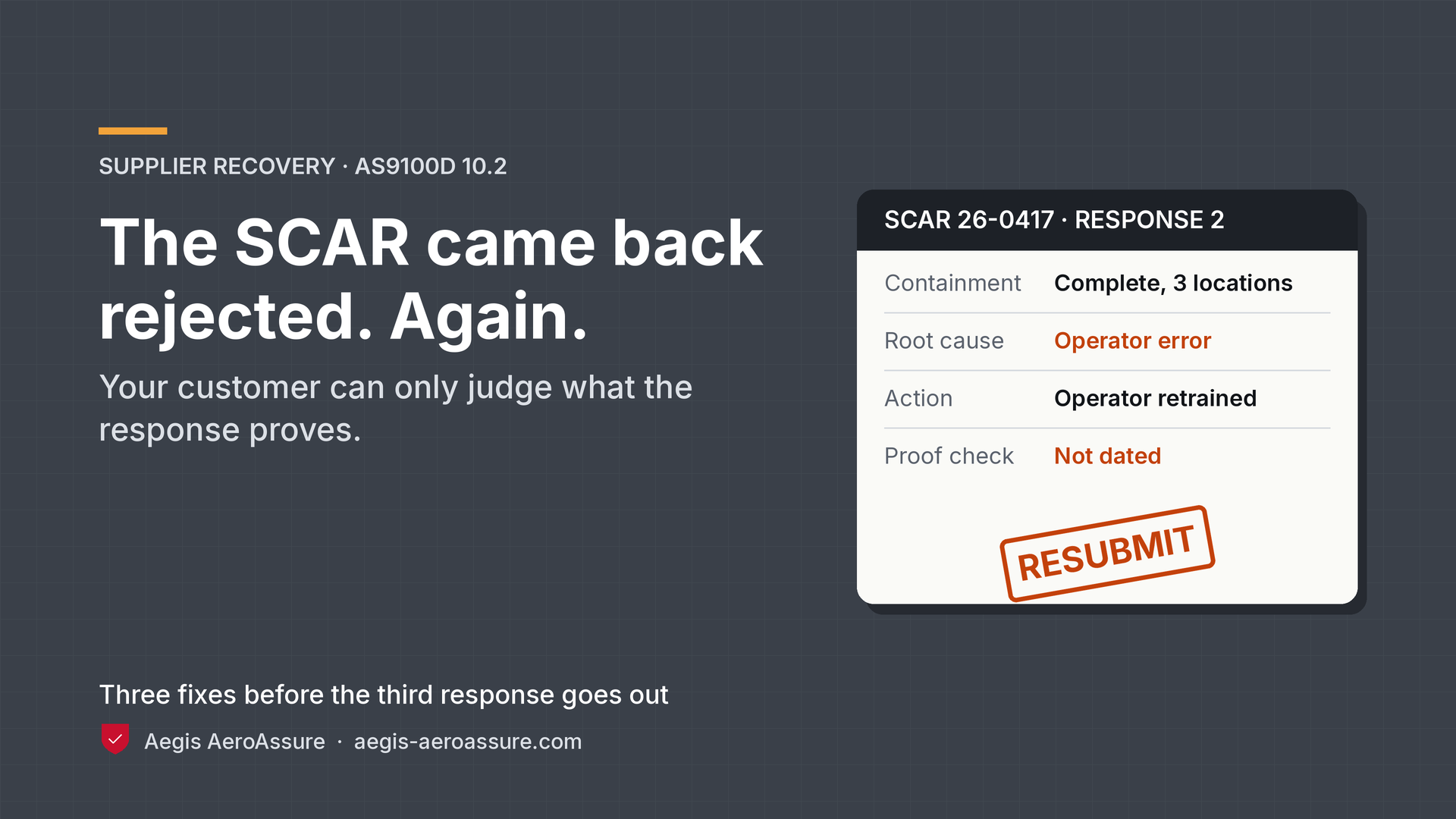
It is Thursday afternoon. The supplier corrective action request from your biggest customer is back in your inbox for the second time, with one line from their supplier quality engineer: "Root cause not adequately identified. Please resubmit."
You did the work. Containment was done the day the escape was reported. You ran the 5-whys, retrained the operator and updated the work instruction. You are a quality team of two, the response took most of a week, and now the clock has started again, with a scorecard behind it.
A SCAR that comes back twice is rarely about effort. It is usually about what the response shows. The engineer reading it cannot walk your floor; all they have is the document. If the document does not prove each step, from their side of the desk the step did not happen.
Here are the three gaps that most often send a response back, and what to put in the next one. Each action names the record that proves it, because that record is what the customer is really asking for.
1. A root cause that explains why, not what
"Dimension out of tolerance" is the problem. "Operator error" is where the analysis stopped. Neither tells your customer why the process allowed the part to be made and shipped.
Push the analysis to two causes, written separately: why the nonconformance occurred, and why it escaped your inspection. A customer who reads only the first will ask for the second. Then test the cause against the evidence: if the cause is "worn tool", show the tool-change record that proves the tool was past its life on that date.
The record: the root-cause section of the 8D or CAPA form with both causes, each with the evidence attached (tool log, inspection record, traveler, photo). If you cannot attach evidence to a cause, it is a hypothesis, and the response should say so and say how you will confirm it.
2. Actions that change the process, not the parts
Sorting the lot, reworking the parts and retraining one operator are containment and correction. They are necessary, and they are not corrective action under AS9100D 10.2, which asks for action that removes the cause so it does not recur.
For each cause from step 1, name one change to the process: a revised work instruction with the new check, a fixture or gauge change, a tool-life limit in the router, an added inspection characteristic at the step that let the part through. Then look sideways: which other part numbers run on the same machine, the same fixture or the same instruction? Your customer will ask.
The record: the revised document with its new revision letter and release date, the change on the router or control plan, and the training record for every person on that operation (not only the one who made the part), dated after the revision.
3. A date for the proof, not just for the action
Most rejected responses end with "Closed". The customer wants to know how you will know it worked. Put a date on the effectiveness check, say what you will measure (the next three lots, 30 days of production, the next first article) and what result counts as effective.
Then do it, and send it without being asked. A short follow-up email with the inspection results on the date you promised does more for your scorecard than a long response.
The record: the effectiveness-check entry in your CAPA log, with the date, the data reviewed and the name of the person who signed it off. Until that entry exists, the CAPA is open in your system, whatever status the customer's portal shows.
Before you press send
Have someone who did not write the response read it against those three points. Ten minutes, their initials and the date on the cover sheet. Whoever wrote a document is the last to see what it leaves out.
Where an evidence pack fits
If the same SCAR keeps coming back, the question behind it is usually bigger than one part: what else in your records would not stand up to the same reading? That is the work Aegis AeroAssure starts from: the records you already keep, exported to spreadsheets, with no new system to adopt first. You get a clause-by-clause AS9100D readiness report and a ranked action plan with named owners, every figure is traced to your own records, and each report is reviewed by an aerospace quality professional before it is released. It is not a certification or a registrar audit; it shows where you stand before one. www.aegis-aeroassure.com
When a SCAR response of yours came back, what was the reason your customer gave?