Insights / The AS9100 Transition File
The AS9100 Transition File, Issue 1 of 7
"Are we ready for IA9100?" Start with your own records
By James T. Porter, Executive Director, Aegis Technologies Inc.
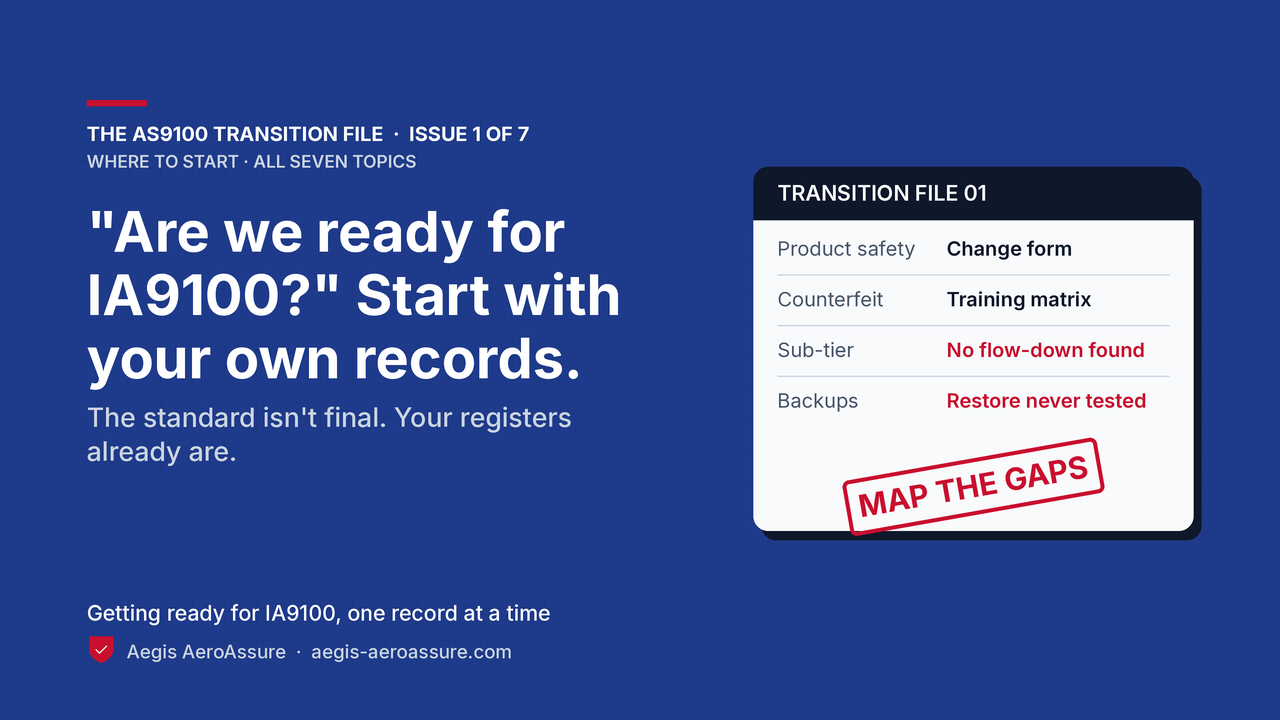
The AS9100 Transition File · Issue 1 of 7. A weekly, practical walk through the IA9100 draft for quality teams at Tier 2 and Tier 3 aerospace suppliers.
The general manager forwards you an email with one line on top: "Are we ready for this?"
Underneath is a customer's supplier bulletin mentioning IA9100, the coming revision of AS9100. You are a two-person quality team. You have a surveillance audit in the spring, a SCAR on the desk and a calibration recall to chase. You also have no copy of the new standard, because there isn't a final one to buy.
So what can you actually do this week?
More than it looks. This newsletter is seven short issues, one a week, each built around one part of the IA9100 draft and the records in your shop that will carry it. Every issue ends with a few actions you can take with the registers you already keep, and a worksheet you can use to do them.
What the IAQG has published so far
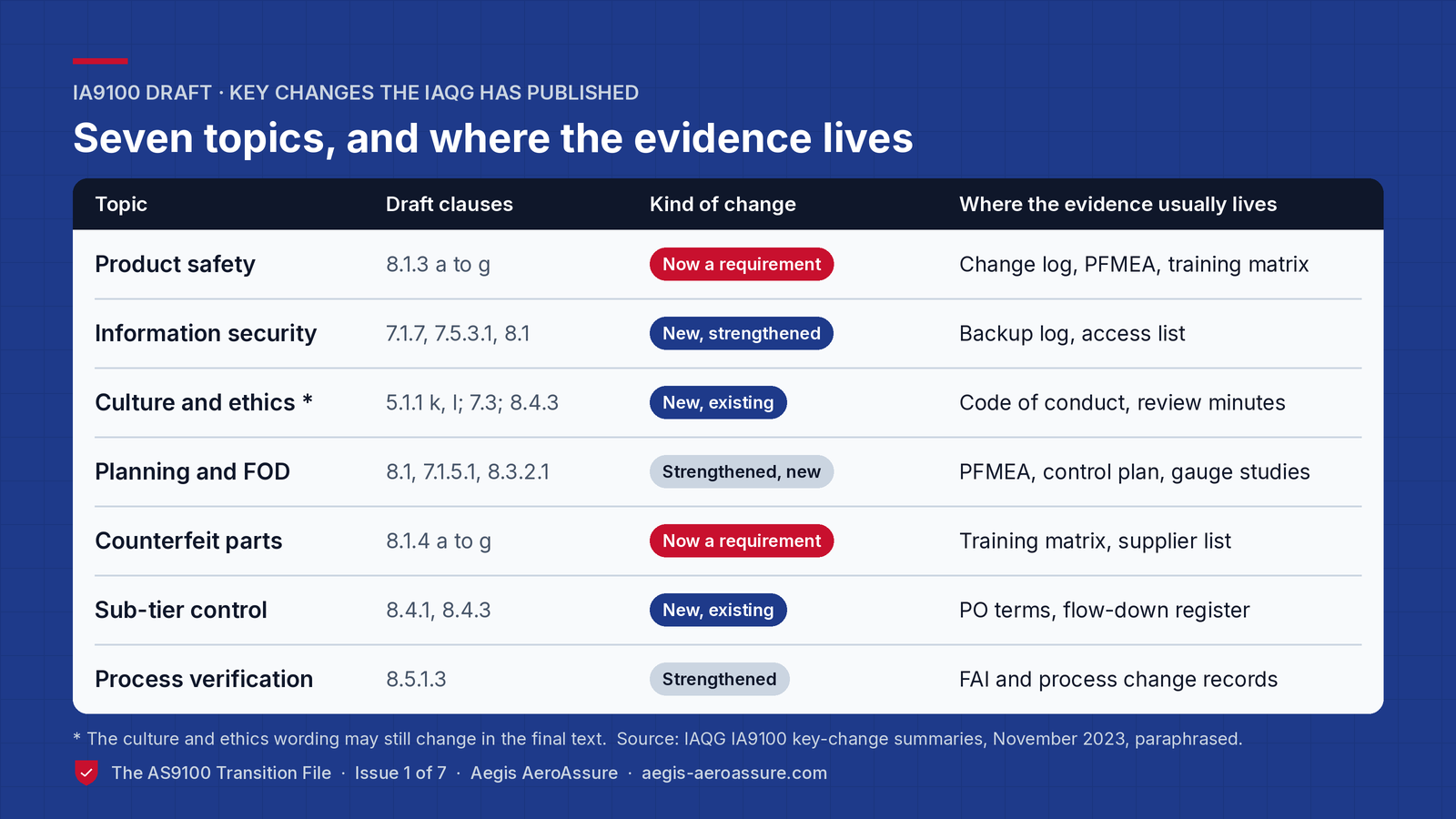
The IAQG has announced a revision is coming. In November 2023 it published key-change summaries of the IA9100 draft, one by clause and one by system. They name where the work will land:
- Product safety (draft 8.1.3)
- Information security and data protection (draft 7.1.7, 7.5.3.1 and a note in 8.1)
- Organizational culture and ethics (draft 5.1.1, with related items in 7.3 and 8.4.3)
- Planning in the style of APQP, with measurement systems analysis and statistical techniques (draft 8.1, 7.1.5.1, 8.3.2.1)
- Foreign object prevention (draft 8.1 k)
- Counterfeit parts prevention (draft 8.1.4)
- Control of sub-tier suppliers (draft 8.4.1, 8.4.3)
- Production process verification that goes beyond first article inspection (draft 8.5.1.3)
The text may still change, and the culture and ethics wording in particular may change in the final text. But the direction is clear enough to start.
Four kinds of change, not one
The summaries don't treat every item the same way. Reading them by the kind of change tells you where the effort is:
- Was guidance, now a requirement. Product safety (8.1.3 a to g) and counterfeit parts prevention (8.1.4 a to g). Most shops already do some of this. The difference is that "some" will need a record.
- New. Information security (7.1.7), the culture and ethics leadership items (5.1.1 k and l), deciding and telling the level of control for sub-tier suppliers (8.4.3), and the measurement systems analysis note (7.1.5.1).
- Strengthened. Foreign object prevention as a planned control (8.1 k), phased APQP-style planning (8.1), statistical techniques (8.1 b), dividing design work into defined activities (8.3.2.1), protecting electronic records (7.5.3.1) and process verification beyond the first part (8.5.1.3).
- An existing requirement, now part of a wider topic. Suppliers controlling their own suppliers (8.4.1), ethics awareness for your people (7.3) and for your suppliers (8.4.3).
Most of these topics sit on records you already keep. The first job is to find out which ones.
Step 1: Map each topic to a record you already keep
One sheet of paper, or one tab in a spreadsheet. List the topics down the side and, beside each, the record where the evidence would live in your shop:
- Product safety: the change log, the PFMEAs, the training matrix
- Information security: the IT backup log and the list of who can log in to what
- Culture and ethics: the code of conduct, the quality objectives, the management review minutes
- Planning, FOD and measurement: PFMEAs, control plans, gauge studies, the FOD procedure
- Counterfeit parts: the training matrix and the approved supplier list
- Sub-tier control: your PO terms, the supplier quality manual and the flow-down register
- Process verification: first article reports and process change records
Some lines will be blank. That's useful already: a topic with no record to look in is your first gap.
The record: the one-page map, dated, with your name on it. It becomes the cover sheet of your transition file.
Step 2: Ask one plain question of each record
Don't read the whole register. Ask one question per topic that a transition auditor is likely to ask, and answer it from the record, not from memory. For example:
- Does the change form ask whether a change can affect product safety, and was it answered on the last five changes?
- Are procurement, receiving inspection, shipping inspection and material control trained in counterfeit-part awareness, with a date?
- Has anyone restored quality records from the off-site backup and opened them?
- Do your PO terms require suppliers to control their own sub-tier suppliers?
- On the last process change, was the process verified, or only the first part inspected?
Then mark each answer one of four ways.
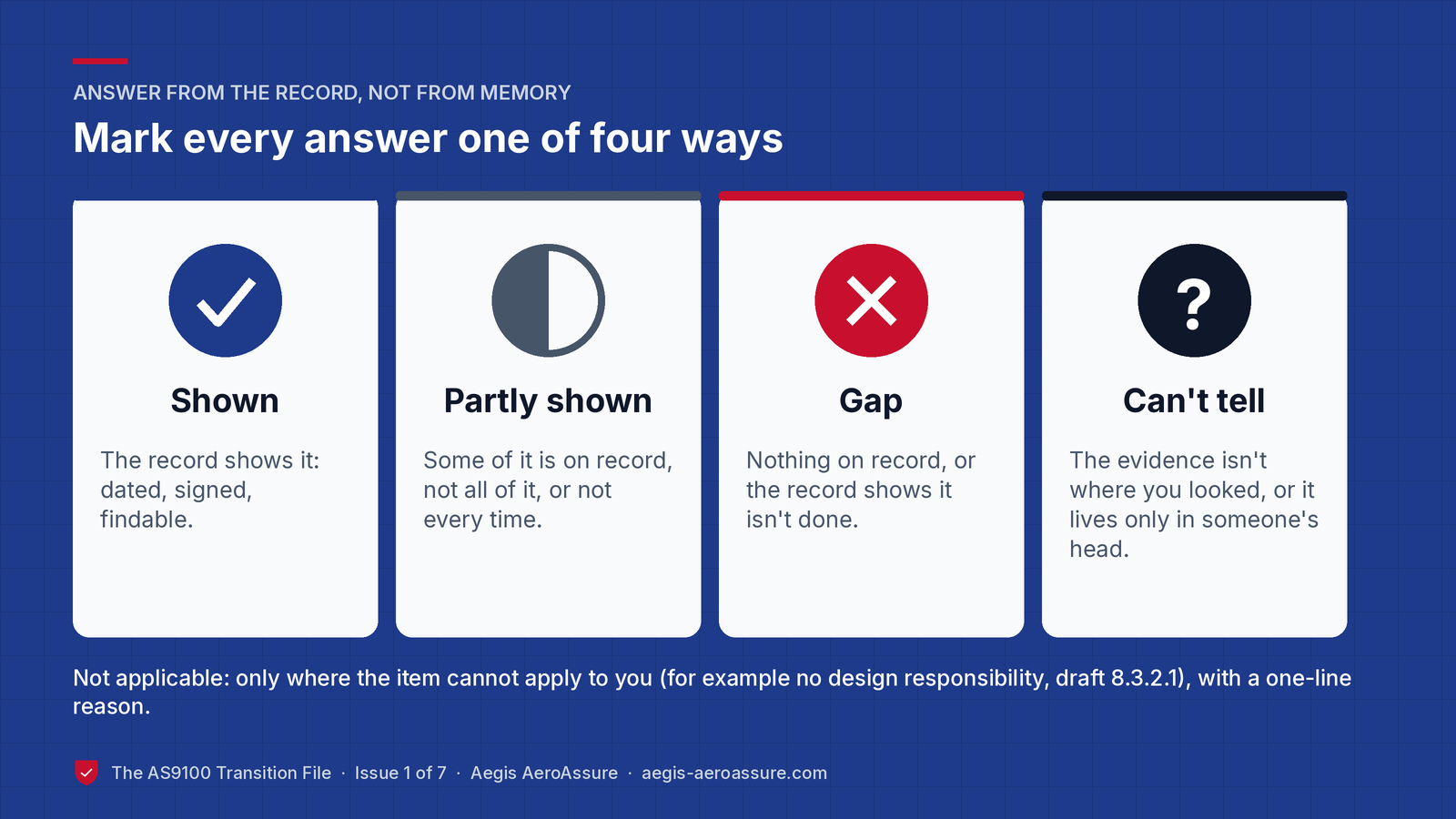
"Can't tell" is an honest answer. It usually means the record exists only in someone's head, which is the same as no record when the auditor asks. If you hold no design responsibility, the design item (8.3.2.1) is "not applicable", with a one-line note saying why.
The record: the self-check sheet, with each question, the record you looked at, the answer, the date and who checked.
Step 3: Open the transition file
Put the map, the self-check and a list of the gaps in one folder, on paper or on the shared drive. Every gap and every "can't tell" goes on your action register with an owner and a date. Then put the list on the agenda of your next management review, so leadership sees it and the decision to resource it gets minuted.
What not to do yet: don't rewrite your quality manual into draft wording that may still change. Fix the records first. The procedures follow once the final text is out.
The record: the actions on the action register or CAPA log, and the management review minute that reviewed them.
This week
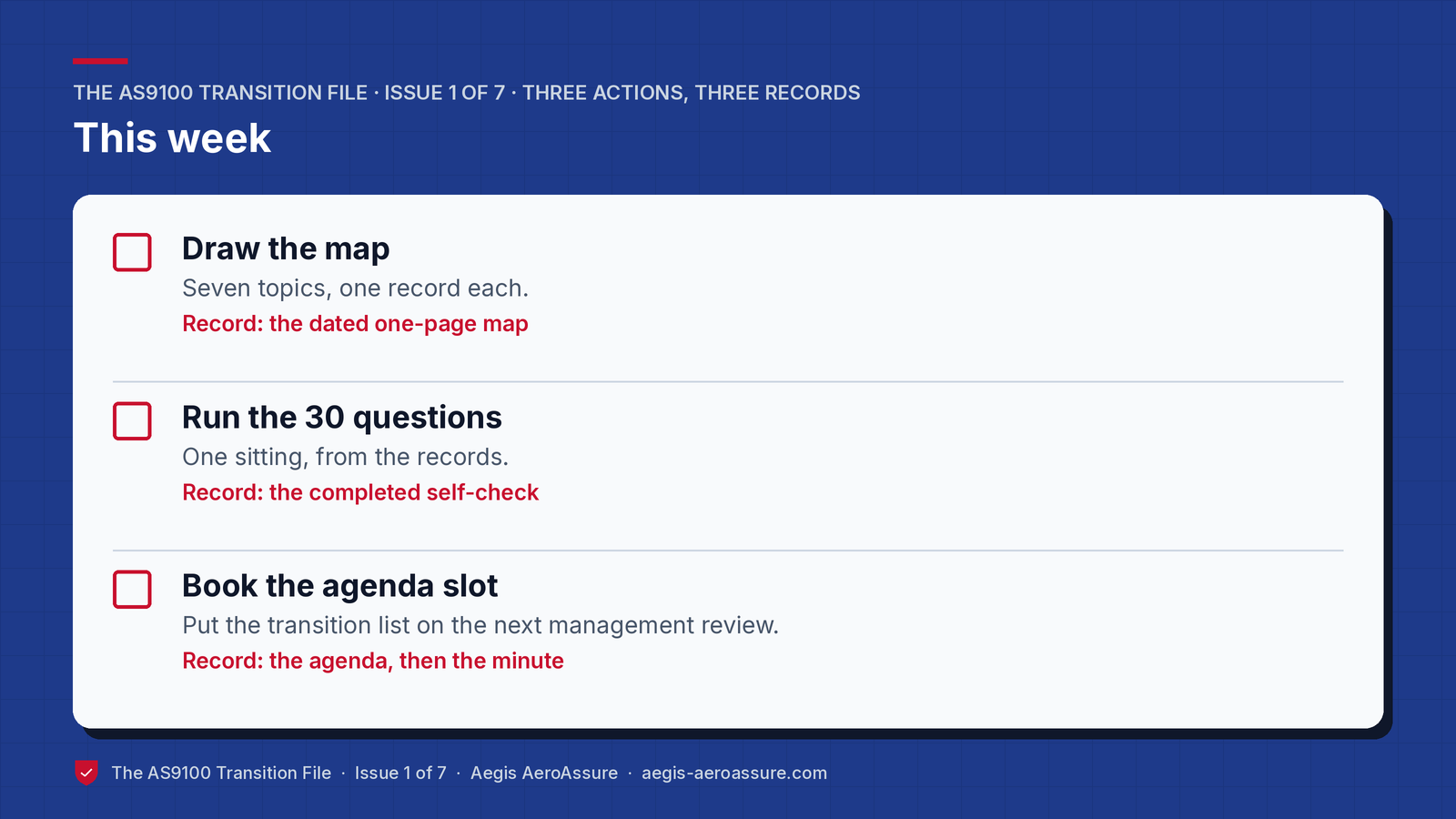
- Draw the map. Seven topics, one record each. Record: the dated one-page map.
- Run the 30 questions. One sitting, from the records. Record: the completed self-check.
- Book the agenda slot. Put the transition list on the next management review. Record: the agenda, then the minute.
The worksheet: IA9100 Transition Self-Check
An Excel workbook (and a printable PDF) with 30 questions across the seven topics, each tagged with its IA9100 draft clause and the kind of change. Mark each one shown, partly shown, gap, can't tell or not applicable, note the record you looked at, and the summary tab counts where you stand by topic. An action-plan tab turns every gap into a dated action with an owner. It comes with a worked example row.
Get it free, the Excel workbook and the printable PDF: book.aegistechnologies.tech/w/ia9100-self-check
Coming up in The AS9100 Transition File
- Product safety: the change form nobody asked about safety (8.1.3)
- Counterfeit parts and obsolescence: the cert looked fine (8.1.4)
- Sub-tier control: your supplier's supplier (8.4.1, 8.4.3)
- Foreign objects, APQP-style planning and process verification (8.1, 7.1.5.1, 8.5.1.3)
- Information security, culture and ethics (7.1.7, 7.5.3.1, 5.1.1)
- Putting it together: your transition plan on one page
Where a gap analysis fits
If you would rather have the full picture done for you: the Aegis AeroAssure IA9100 Transition Gap Analysis takes the same intake as our Audit Defense Pack (your quality records in our Excel templates, plus a short set of transition questions) and shows, for each new or changed requirement in the IA9100 revision of AS9100, whether your records show it, partly show it, show a gap, or cannot be judged from what you sent, with a ranked action plan to close the gaps before your transition audit. IA9100 is not yet final: measured against the IA9100 changes the IAQG has published to date, and the final text may still change these topics. It is not certification or a registrar audit; it shows where you stand before your transition audit. www.aegis-aeroassure.com/ia9100-gap-analysis
Which IA9100 topic would you check first in your own shop, and why that one?
Also on LinkedIn: The Audit Ready Brief, six issues on the threads an AS9100D auditor follows through your records today, from audit prep time to audit week. Its issues are shared on James T. Porter's profile: linkedin.com/in/james-t-porter
About IA9100: the IAQG has announced that a revision of AS9100 is coming as IA9100. It is not yet final. This newsletter is based on the IAQG's published key-change summaries of the IA9100 draft (System View and Clause View, November 2023), paraphrased, not quoted. Clause numbers are the draft's, and the final text may change any of these topics.
James T. Porter, Executive Director, Aegis Technologies Inc.