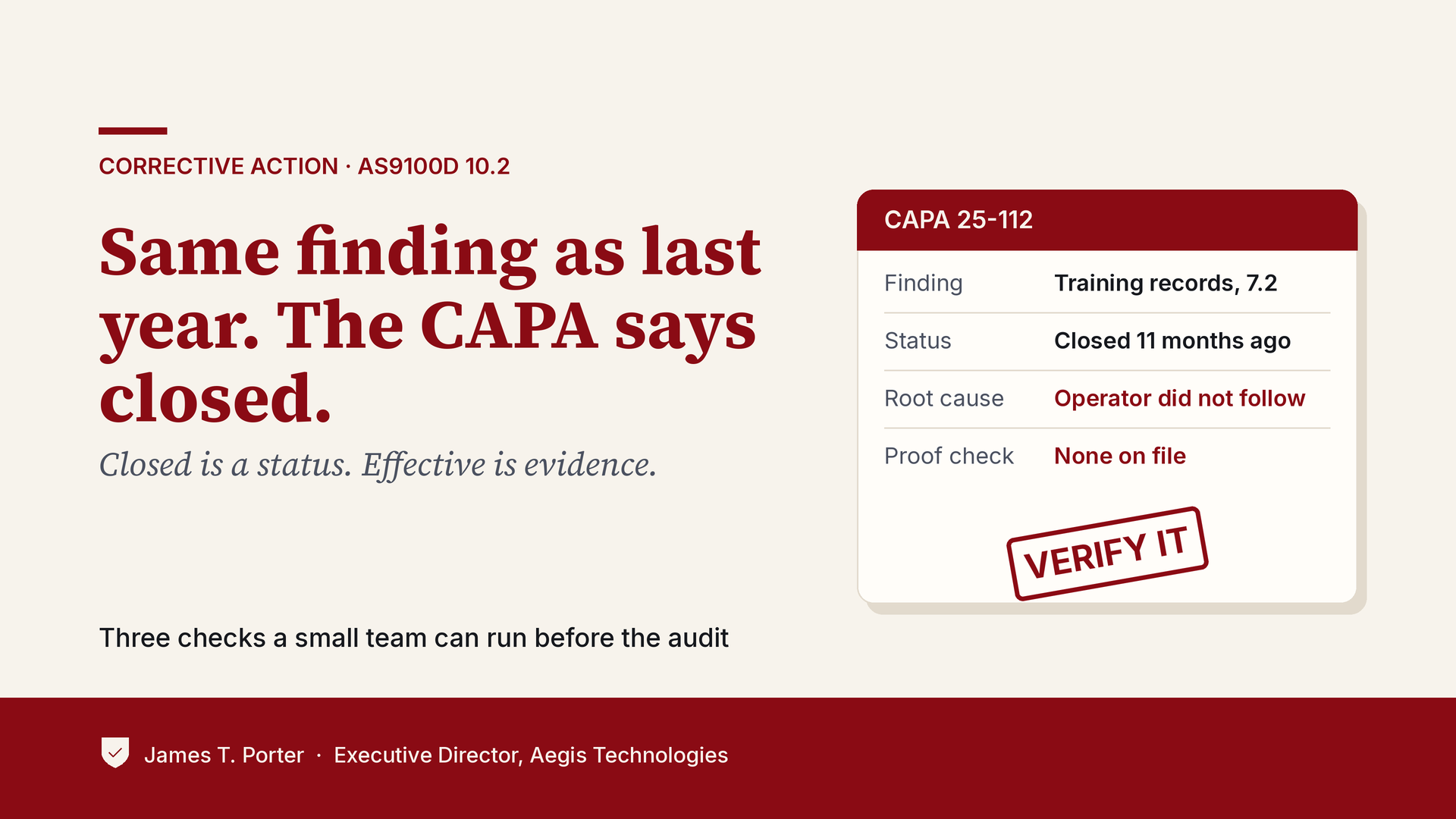
The surveillance audit is three weeks out. You open last year's report to see what the auditor will look at first, and there it is: the same clause, nearly the same words, as the finding you closed eleven months ago. Training records not current for a special-process operator. Or a gauge used past its calibration date. Or a drawing at the machine one revision behind.
The CAPA for it is in your log, marked closed, with a root cause, an action and a signature. And yet a walk through the shop this morning would turn up the same thing again.
A repeat finding can be raised to a major, because it suggests the corrective action process itself did not work, not just one record. It is also the finding a small team can do the most about in three weeks, because the work is already half done: the old CAPA tells you exactly where to look.
Three checks, each with the record that proves it was done.
1. Re-read the old root cause as if you were the auditor
Pull the CAPA you closed last year and read only the root-cause line. If it names a person ("operator did not follow procedure", "inspector missed it"), the analysis stopped one step early. The question an auditor will ask is why the system let a person miss it: no reminder before the qualification lapsed, no check at the machine that the drawing revision matched the router, no hold on a gauge past its due date.
Write the system cause next to the old one. If it is different, the original action was aimed at the wrong thing, and that explains the repeat.
The record: a new CAPA opened for the repeat, referencing the old CAPA number, with the revised root cause and the reason the first one did not hold. Opening it yourself, before the audit, is very different from having it opened for you.
2. Check whether the action reached every place the cause lives
Last year's action probably fixed the instance the auditor found: one operator retrained, one gauge recalibrated, one drawing replaced. The cause was usually wider. If qualifications lapse because nobody tracks expiry dates, every qualified person is exposed, not one.
Make the action systemic and test its reach: a list of every special-process qualification with its expiry date and an owner who reviews it monthly; a recall list that blocks any gauge past due; a check of every drawing at the machines against the current revision, not just the one that was found.
The record: the list or register itself, with the date you checked every entry, and a sample you can hand the auditor: three operators, three gauges or three drawings picked at random, all current, with the check signed and dated.
3. Prove it worked, with a date and a number
The old CAPA most likely closed when the action was done. AS9100D 10.2 asks you to review the effectiveness of the corrective action taken, and that review is what was missing. Effective means the condition has not come back over a period long enough to mean something.
Set the period now (the last 90 days of records is a fair start), look at the data and write down what you found: how many qualifications came due and were renewed on time, how many gauges were recalled before their date, how many drawings you checked and how many were current. If the answer is not clean, the CAPA stays open and you say what you are doing next. An open CAPA with an honest plan reads better to an auditor than a closed one that the shop floor contradicts.
The record: the effectiveness-review entry in the CAPA log, with the period reviewed, the result, and who signed it off.
Three weeks is enough
You do not need a new system for any of this. You need last year's report, the CAPA log, and a few hours of looking at your own records the way an auditor will.
Where an evidence pack fits
Repeat findings are hard to see from inside one register, because the training matrix, the calibration log and the CAPA log rarely sit side by side. Aegis AeroAssure starts from the records you already keep, exported to spreadsheets, and produces a clause-by-clause AS9100D readiness report and a ranked action plan with named owners, with every figure traced to your own records. It ends with an audit checklist: the questions an auditor asks about each clause where your records show a gap, and the evidence to have ready. It is not a certification or a registrar audit; it shows where you stand before one. www.aegis-aeroassure.com
Which finding has followed your shop from one audit to the next, and what finally made it stop?